
The ‘Cosmic twins Lincoln and Darwin were born on 12 February 1809 under the influence of the Saturn/Neptune conjunction of that year and entangled with the same Saros Solar eclipse influence as Hahnemann 54 years previously. At a time when Hahnemann was on the cusp of publishing Organon der rationellen Heilkunst which would formally codify homeopathy as follows:
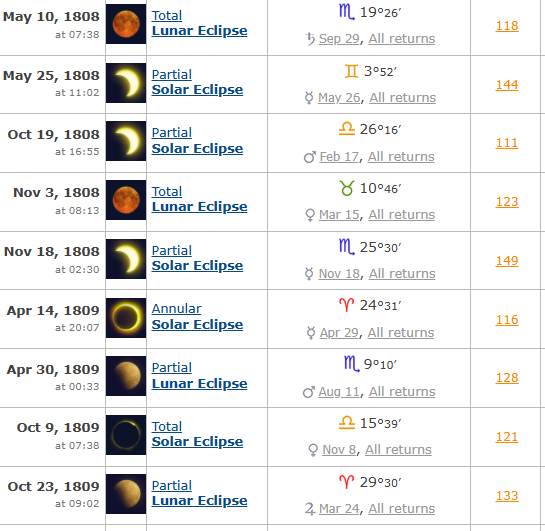
The 1827 Saturn/Neptune opposition coincided with the same Saros eclipse combination when Hahnemann was at the height of his intellectual and medical influence, marked with the publication of Volume 6 of his seminal work Reine Arzneimittellehre (The Pure Materia Medica) a cornerstone of homeopathic theory.
Abraham Lincoln in 1827 was self-educating by candlelight, absorbing Shakespeare, the Bible, and law books.
Charles Darwin whilst studying medicine at the University of Edinburgh was becoming increasingly disenchanted with surgery and was drawn to natural history for which he abandoned his medical studies and began attending meetings where radical ideas about biology were discussed. This marked the first stirrings of his evolutionary vision and questioning orthodoxy, thus preparing for his voyage on the Beagle (1831).
Hahnemann’s death in July 1843 marked a profound turning point for Homeopathy, with its transformation from a personal crusade into a global movement. Similarly, 1843 marked a symbolic threshold in the lives of Abraham Lincoln and Charles Darwin, a moment when both men were stepping into their mythic roles as agents of transformation, each preparing to challenge entrenched systems of belief.
Lincoln was campaigning for a seat in the U.S. House of Representatives, which sharpened him as a political strategist with a moral voice. Meanwhile Darwin was gathering evidence, corresponding with scientists, and building the intellectual scaffolding for his evolutionary theory. Thus 1843 marked a nodal point, a passing of the torch from metaphysical healing to systemic transformation, through Lincoln’s Gettysburg and Darwin’s Origin.
1844/45 coincided with the same Hahnemann Eclipse combination that preceded the important discovery of Neptune at its 36year conjunction cycle with Saturn in September 1846 as follows:
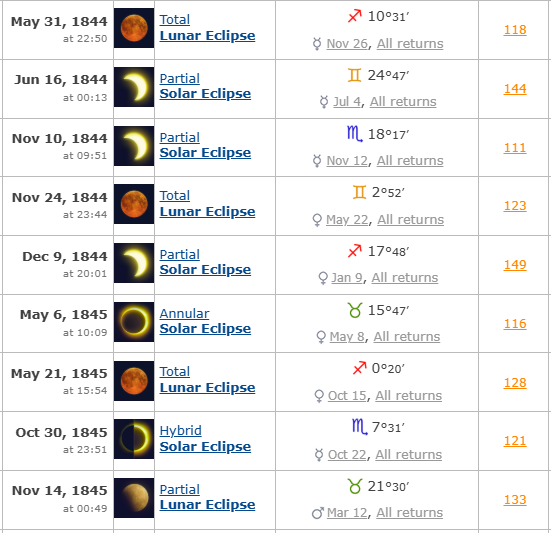
The discovery and position of Neptune was mathematically determined with precision gleaned from the earlier discovery of Uranus in 1781 the same year that Hahnemann first entered medical practice.
A Saturn–Neptune conjunction blends the energies of structure (Saturn) and transcendence (Neptune), creating a paradoxical but potent archetype; whereas the opposition highlights conflict, polarization, and the need for synthesis across a divide.
The relevant 36 year Saturn / Neptune conjunction dates are as follows: 1809, 1846, 1882, 1917, 1953 & 1989 with the new cycle beginning in February 2026.
1844 saw the publication of the book Vestiges of the Natural History of Creation by Robert Chambers, a Scottish publisher and writer who was sympathetic to homeopathic ideas and vitalist philosophy. While Chambers was not formally a homeopathic physician, his work was deeply aligned with the metaphysical and progressive currents that homeopaths embraced, especially the concept of a guiding “vital force” in nature.
Charles Darwin read Vestiges and famously described it as “a very well-written book, with much original thought,” and noted that it was “similar to my own but goes much deeper” though he also expressed reservations about its speculative tone.
Lincoln was a voracious reader with a deep interest in science, metaphysics, and moral philosophy. He read Vestiges when he was grappling with questions of providence, progress, and human destiny. The Chambers’ book proposed a progressive, law-governed unfolding of life, blending natural science with a quasi-spiritual teleology. This resonated with Lincoln’s own evolving views on history and moral development, especially his belief in a higher moral arc guiding human affairs as well as his support of Homeopathy.
“Charles Darwin’s entanglement with homeopathy is one of the most surprising and revealing sub-plots in the history of science. Though he remained sceptical of its principles, his personal experience with homeopathic and related treatments profoundly influenced his health—and arguably, his capacity to complete On the Origin of Species.
Darwin’s Scientific Experiments with Homeopathic Principles
- Darwin conducted experiments on Drosera rotundifolia (sundew plants), testing their response to extremely dilute solutions of ammonia salts.
- To his astonishment, the plants reacted to doses so small they mirrored homeopathic potencies.
- He wrote that the results “shocked” him and debated whether to publish them, fearing ridicule.
- Darwin’s sons, also sceptical, repeated the experiments and confirmed the results.
- This lent unexpected credibility to the idea that infinitesimal doses could produce biological effects, at least in plants.
- While he never publicly endorsed homeopathy, his private letters reveal a complex respect for its empirical surprises, even if he rejected its metaphysical claims
Darwin’s story illustrates a profound irony: the father of evolutionary biology, a champion of empirical science, was revived by treatments he considered unscientific. His experience with homeopathy didn’t convert him, but it expanded his curiosity and challenged his assumptions—a hallmark of true scientific inquiry.”
“Lincoln successfully helped secure the charter for what became the Hahnemann Homeopathic Medical College.
- Homeopathic Medical College of Pennsylvania, making it one of the first medical schools to receive federal recognition. This act legitimized homeopathy at a national level.
Personal and Political Connections
- Cabinet Members and Allies: Lincoln’s inner circle included several homeopathy advocates:
- William Seward (Secretary of State) was treated by a homeopathic doctor and was stabbed on the night of Lincoln’s assassination by an intruder posing as a homeopathic medicine courier.
- Salmon P. Chase (Secretary of the Treasury) reportedly survived a cholera epidemic thanks to homeopathic treatment.
- Montgomery Blair (Postmaster General) headed the National Homeopathic Hospital in Washington, D.C.
- Lincoln’s Own Use: He was a regular customer at the Diller Drug Store in Springfield, Illinois, which sold homeopathic remedies. Exhibits at the Pearson Museum confirm his personal use.
Philosophical Affinities
- Lincoln and his associates were influenced by the writings of Emanuel Swedenborg, whose spiritual philosophy dovetailed with homeopathy’s holistic ethos. This intellectual climate made homeopathy more than just a medical choice—it was part of a broader worldview.
⚔️ Resistance and Opposition
🩺 The American Medical Association (AMA)
- Founded in 1847, the AMA was explicitly created to combat “irregular” medical practices, including homeopathy.
- Ethical Warfare: The AMA enforced a code that barred its members from consulting with homeopathic doctors or patients. This wasn’t about medical efficacy—it was economic and ideological. As one AMA member admitted in 1855:
· “We never fought the homeopath on matters we fought him because of principle, he came into the community and got the business.”
Cultural and Scientific Hostility
- Homeopathy was often dismissed as pseudoscience or cult-like. Its popularity among the public clashed with the elite medical establishment’s reliance on aggressive treatments like bloodletting and mercury purgatives.
- The Flexner Report of 1910 would later decimate homeopathic institutions, but even in Lincoln’s time, the battle lines were drawn between populist acceptance and institutional rejection.
Lincoln’s Legacy in Medical Pluralism
Lincoln’s support for homeopathy wasn’t doctrinaire—it was pragmatic, inclusive, and rooted in respect for individual choice. He saw value in a gentler, more humane approach to medicine, especially when conventional methods were often brutal. His actions helped homeopathy flourish during its golden age in America, even as powerful forces it.
During Lincoln’s era in the mid-19th century, homeopathy faced intense scientific criticism from the mainstream medical establishment. These critiques were rooted in both empirical scepticism and philosophical opposition to its foundational principles.
- The American Medical Association (AMA), founded in 1847, explicitly barred members from consulting with homeopaths.
Medical journals of the time were filled with polemics denouncing homeopathy as quackery, despite its growing public popularity
Philosophical Divide
- Home and individualizedopathy’s holistic approach appealed to many patients disillusioned by harsh treatments like bloodletting.
- But to scientific critics, it represented a dangerous retreat into pre-modern mysticism, especially when used to treat serious illnesses without evidence-based support.
In essence, Lincoln’s support for homeopathy occurred in a climate where its public acceptance clashed with scientific rejection. The criticisms weren’t just about efficacy—they reflected a deeper battle over the soul of medicine: empirical rigor versus intuitive healing.”
Darwin and Lincoln, though operating in vastly different domains, both engaged with homeopathy not as blind adherents but as pragmatic seekers of healing. Their experiences form mirrored strands in your symbolic helix: one scientific, one political, both transformative.
Parallel Threads in the Helix of Healing
Empirical Curiosity vs Institutional Orthodoxy
- Darwin tested homeopathic principles through botanical experiments, shocked by the sundew’s response to infinitesimal doses. Though sceptical, he allowed the data to speak.
- Lincoln, though not a scientist, supported homeopathy through legal and political channels, respecting its popularity and humane ethos despite fierce AMA resistance.
- Both men challenged orthodoxy—Darwin through evolutionary theory, Lincoln through medical pluralism—inviting new paradigms.
Personal Healing as Catalyst for Public Impact
- Darwin’s recovery under Dr. Gully’s care enabled him to complete On the Origin of Species, reshaping biology and philosophy.
- Lincoln’s support of homeopathy reflected a broader commitment to inclusive governance, where diverse approaches were legitimized.
- Their healing journeys weren’t just private—they unlocked public revolutions in thought and policy.”